
Waterproofing Guides
Roof Leakage in Dehradun: 7 Common Causes & Permanent Waterproofing Solutions
If your ceiling is wet after every monsoon spell, the problem is almost certainly not where you think it is. This guide explains the real causes, how to find the actual entry point, and which solutions actually last.
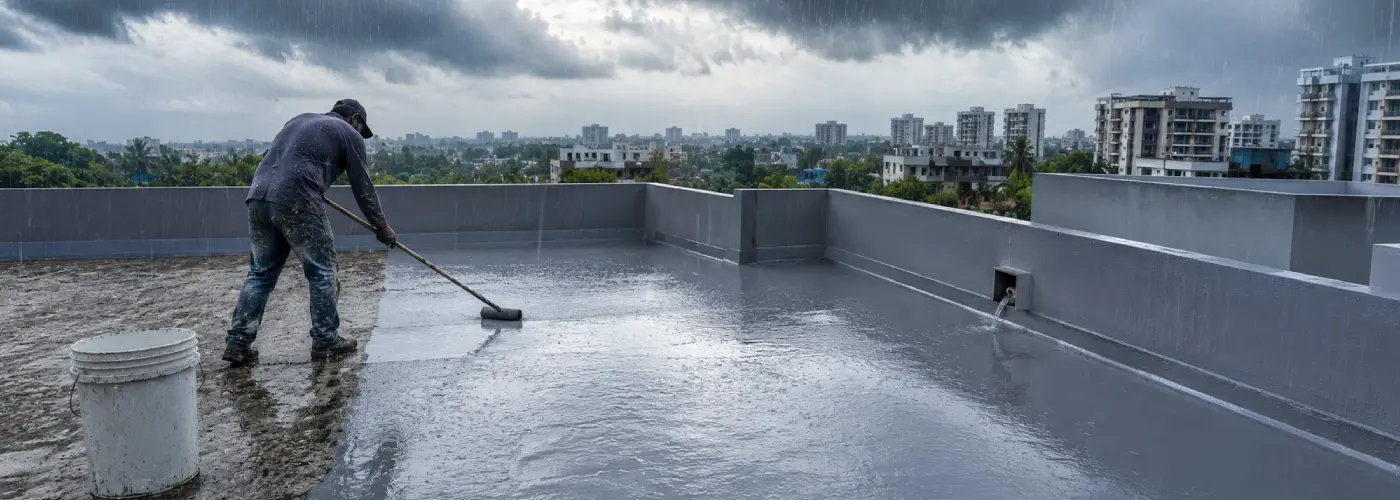
Roof leaking?
Book a free site inspection. We find the actual source before quoting anything.
- No inspection charges
- Written quote before work
- Branded certified materials
- Written workmanship warranty
A water stain appears on your bedroom ceiling in July. Someone fills the crack on the terrace above. It holds through August. Next July, the stain is back – slightly wider, and now the plaster is beginning to bubble. This pattern plays out in homes across Dehradun every monsoon, and it repeats for one reason: the crack was patched, not the leak.
Finding a genuine roof leakage solution in Dehradun means understanding what is actually causing water to enter – which is rarely obvious from the inside of the building – and then treating it with the right system, not the nearest available product. This guide covers both.
Key point: The wet patch on your ceiling is rarely directly below where water enters. Water travels along the slab before it surfaces. Treating the ceiling stain without finding the terrace-level entry point is why most roof leakage repairs fail.
7 Common Causes of Roof Leakage in Dehradun
Most cases of roof and terrace leakage in this region trace back to one or more of the following causes. Identifying which applies to your building is the starting point for any lasting repair.
The Doon Valley Rainfall Factor
Dehradun is one of the wetter cities in North India. The monsoon does not arrive as a few dramatic storms – it settles in for weeks. That distinction matters more than the total figure:
1
Cracks in the Concrete Slab
RCC slabs develop hairline cracks naturally over time. Dehradun’s daily temperature swing – warm afternoons, cooler nights – causes the concrete to expand and contract, gradually widening cracks that were initially invisible. Once a crack reaches the reinforcement depth, water reaches the steel and the damage compounds. Cracks at the parapet junction and near structural columns are particularly common entry points.
2
Degraded or Damaged Waterproofing Layer
A previous waterproofing coating that has reached the end of its service life is one of the most frequent causes of recurring monsoon leakage. Acrylic coatings typically last 3-5 years; once they degrade, they no longer form a barrier and often trap moisture beneath them, accelerating the underlying damage. Applying a new coat over a failed one without removing it extends the problem rather than solving it.
3
Poor Slope and Drainage
Terraces are constructed with a slight slope so rainwater drains quickly to the outlets. When this slope fails – due to settlement, poor original construction, or accumulated repair layers – water ponds on the surface. Standing water exerts sustained hydrostatic pressure on any coating, forcing it into cracks and eventually through the slab. This is one of the main reasons leakage problems accelerate in Dehradun’s multi-week monsoon: the terrace stays wet between spells.
4
Blocked or Damaged Rainwater Outlets
Scupper drains, downpipes, and roof outlets clogged with leaves, debris, or bird nests prevent water from leaving the terrace. The resulting ponding then finds any weakness in the surface. This cause is often overlooked because the outlet may appear to be functioning – it only blocks fully when a heavy rainfall overwhelms a partially obstructed pipe.
5
Gaps at Pipe Collars and Service Penetrations
Every pipe, conduit, or service line that passes through the terrace slab is a potential water entry point. The gap between the pipe and the slab is typically sealed during construction, but that seal cracks as the pipe expands and contracts with temperature changes. Overhead water tanks with inadequate base waterproofing are another common contributor, particularly visible as water stains directly below the tank.
6
Parapet Wall and External Wall Seepage
The junction between the terrace slab and the parapet wall is a stress concentration point – it moves differently from the slab, opening and closing with each temperature cycle. If this junction is not correctly sealed and protected, water enters horizontally along the wall and travels down to appear as a ceiling stain in the room below. External brick wall waterproofing and proper parapet treatment are often required alongside terrace work.
7
Old, Poor-Quality, or Incompatible Previous Waterproofing
Many older Dehradun homes have three, four, or even five successive layers of waterproofing coating applied over one another without proper surface preparation between applications. Each new layer bonds to the failed layer below it rather than to the concrete, creating a laminated structure that peels as a unit. When this happens, the entire stack must be removed before any new treatment will hold.
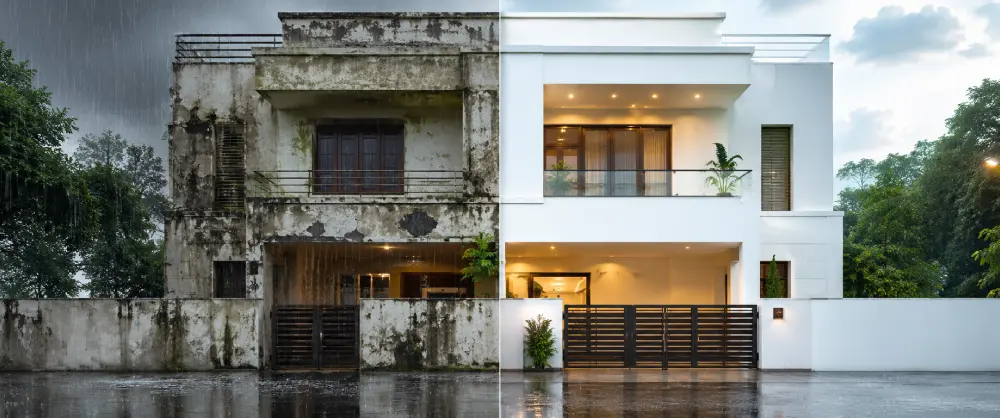
Signs That Your Roof Has a Waterproofing Problem
Water damage is quiet for a long time before it becomes visible. Most of the signs below appear well before a drip, which is why acting early costs significantly less than waiting.
Ceiling Damp Patches
Yellow or grey patches that grow after rain and shrink in dry weather. The size of the patch often does not correspond to the size of the entry point above.
Peeling or Bubbling Paint
Paint separates from the plaster when moisture accumulates behind it. Often appears first at the corners of rooms on the top floor.
Mould or Fungal Growth
Black or green patches on ceiling or upper walls indicate sustained moisture. Mould behind paint or plaster means water has been present for longer than it appears.
Efflorescence (White Powder)
A white, chalky deposit on plaster or brickwork. Salt is being carried to the surface by water moving through the material – a reliable sign of active water movement.
Recurring Stains After Rain
The same stain reappears in the same location after every monsoon spell, even if it was painted over. This pattern confirms active water ingress rather than old moisture.
Cracks on the Terrace Surface
Visible cracks on the terrace floor, especially around the parapet base, near drainage outlets, or at column lines. These are the highway for rainwater into the slab.
Musty Smell
A persistent musty or earthy smell in a room, even when it appears dry, suggests moisture trapped in the wall or slab. Often present well before any visual sign appears.
Rust Stains on Ceiling
Brown or reddish staining on a concrete ceiling is water reaching the steel reinforcement. This is past the cosmetic stage – structural review is needed alongside waterproofing.
Take rust stains seriously. Once water reaches the reinforcing steel, corrosion expands the metal and fractures the surrounding concrete – a process called spalling. Addressing leakage before this point costs a fraction of the repair required after it.
How to Find the Actual Source of Roof Leakage
The wet patch on your ceiling is an exit point, not the entry point. Water enters the slab through a crack, a joint, or a gap – often several feet away from where it surfaces – and travels along the slab following the path of least resistance before finding a way through to the room below.
This is why sealing the ceiling stain with waterproof paint or putty never works. You are blocking the exit, not the entrance. The water simply finds the next gap.
A professional traces the source by working from the terrace surface above:
- Examining the slab surface for cracks, open joints, and deteriorated coating
- Checking all parapet wall junctions for separation or cracking at the slab-wall interface
- Inspecting every pipe penetration, drainage outlet, and water tank base for gap or seal failure
- Assessing the slope – whether water drains away from the surface or ponds
- Looking for previous patch repairs, which are often the first points to fail again
In some cases a controlled water test – wetting a specific area of the terrace and observing where it surfaces below – helps confirm the path. For active cracks in basements or walls, injection grouting can also be used diagnostically to trace the crack path.
The diagnosis determines the repair. Without it, any treatment is a guess.
Roof Leakage Repair vs Roof Waterproofing: What Is the Difference?
Roof leakage repair addresses a specific, identified defect – a crack at a pipe collar, a failed joint at the parapet, a single crack in the slab. It is the right approach when the problem is localised and the rest of the surface is in good condition.
Roof waterproofing applies a continuous protective system across the entire terrace surface. It is the right approach when the existing coating has degraded across most of the surface, when there are multiple crack entry points, or when the roof has leaked repeatedly despite previous patch repairs.
| Situation | Appropriate approach |
|---|---|
| Single crack, isolated leak, rest of surface intact | Targeted repair (crack injection or sealant) |
| Degraded coating across most of the terrace | Full waterproofing treatment |
| Leakage at pipe collar or drainage outlet only | Targeted repair at the penetration |
| Recurring leakage season after season | Full surface assessment + waterproofing |
| Multiple old coating layers, no bond to slab | Strip, prepare, full waterproofing |
| Water ponding after rain (slope failed) | Slope correction + full waterproofing |
| First leak on a relatively new surface | Inspection to identify; then targeted repair |
The choice between repair and full waterproofing is made at the inspection stage. Our roof waterproofing and terrace waterproofing service pages explain the full process for each approach.
Best Waterproofing Solutions for Roof Leakage
The right solution is always determined by the site condition, not a catalogue. That said, four systems account for most residential roof leakage solutions in Dehradun:
PU (Polyurethane) Waterproofing
A seamless elastomeric coating applied in multiple coats with fibre mesh reinforcement at junctions. PU’s key advantage is flexibility – it bridges hairline cracks that open and close with temperature change rather than tearing at them. It is UV-stable, walkable, and has a typical service life of 7-10 years on a correctly prepared surface.
Best for: Exposed residential terraces in reasonable structural condition. The most commonly specified system for roof leakage repair in Dehradun where the slab does not need slope correction.
Liquid Membrane (Acrylic Elastomeric Coating)
A water-based elastomeric coating applied by brush or roller, curing to a flexible seamless film. The entry-level waterproofing option – more economical per sq ft but with a shorter service life of 3-5 years before reapplication is needed. Suitable for terraces in good condition where budget is the primary constraint.
Best for: Lighter applications, ancillary areas, or situations where a system will be reapplied on a short cycle. Not recommended as a permanent solution for a terrace with significant existing damage.
Cementitious / Crystalline Waterproofing
A cement-based compound that reacts with moisture inside the concrete to form crystals that block the capillary pores. Works from within the slab rather than as a surface skin, so it cannot peel. Particularly effective on water tanks, basement walls, and surfaces where negative-side (inside-face) treatment is needed.
Best for: Water tanks, underground walls, and locations where positive-side access is not possible. Not a substitute for a surface membrane on an exposed terrace.
APP Bituminous Membrane
Factory-manufactured polymer-modified bitumen rolls torch-applied to the slab. A robust system with high puncture resistance, typically used under a protective tile or screed layer. The overlapped seams require careful torching to avoid future joint failures.
Best for: Large flat roofs or terraces that will receive a tile finish. Also appropriate where brickbat coba is not possible but a heavy-duty membrane is needed.
Brickbat Coba with Tile Finish
The traditional system: a sloped mortar bed of broken brick, set with waterproof mortar and finished with china mosaic or ceramic tiles. Corrects slope, insulates the top floor, and is fully walkable. The longest-lasting approach for a terrace needing comprehensive treatment, with a service life of 10-15 years when done correctly.
Best for: Terraces with failed slope, multiple old coating layers, or where a comprehensive treatment with maximum longevity is needed.

How Roof Leakage Is Professionally Repaired: Step by Step
A professional roof leakage solution in Dehradun follows a logical sequence. Skipping any stage – particularly surface preparation – is the most common reason a new treatment fails alongside the old one.
- Site Inspection and Diagnosis – Examining the terrace surface, parapet junctions, pipe penetrations, drainage, and any previous repairs to identify all active water entry points. This step determines both the repair scope and the appropriate system.
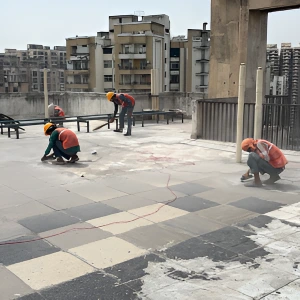
- Surface Preparation – Removing all existing failed coating by grinding or pressure washing. Cutting back any deteriorated concrete. Cleaning the surface of dust, oil, and contamination. This is the most labour-intensive and most critical step: no waterproofing system will bond to a surface it cannot adhere to.
- Crack and Joint Treatment – Cutting cracks to a uniform “V” or “U” profile, cleaning, and filling with a compatible polymer-modified mortar or PU sealant. Treating construction joints and the parapet wall junction with a flexible sealant and mesh reinforcement.
- Priming – Applying the correct primer for the chosen system. Primer improves adhesion, seals the concrete surface, and in some systems provides a tie-coat between the repair mortar and the waterproofing layer.
- Waterproofing Application – Applying the specified system in the correct number of coats at the manufacturer’s specified coverage rate. Critical details – parapet junction, pipe collars, drainage outlets – receive additional reinforcement before the main area is coated.
- Drainage Check and Slope Verification – Confirming that outlets are clear and that the surface falls correctly toward them. If slope correction was part of the scope, verifying the gradient before the waterproofing coat is applied.
- Quality Inspection and Water Test – Allowing the system to cure fully, then conducting a 24-48 hour ponding test where the terrace is flooded to a shallow depth and the ceiling below is checked for any seepage. Handover takes place after the test is passed.
Why Temporary Roof Leakage Repairs Often Fail
Several repair approaches are genuinely temporary – they contain the problem for a season or two but do not address the underlying cause. Understanding why they fail helps in evaluating what a contractor is proposing.
Coating Over Failed Material
Applying a new waterproofing coat over an existing coating that has lost adhesion transfers the bond problem to the new coat. The new layer is only as good as what it bonds to – which, in this case, is a coating that has already failed. Both layers will eventually peel together.
Treating the Ceiling Instead of the Roof
Waterproof paint or sealant applied to the ceiling stain blocks the exit point, not the entry. Water pressure builds behind the seal and forces its way through the next available path – often appearing as a new stain a short distance from the original.
Applying Waterproofing to a Wet Surface
Most waterproofing products require a dry substrate and an adequate curing window. Applying a coating to a damp slab during monsoon season prevents proper bonding; the coating lifts when the moisture beneath it eventually evaporates or when the next rain arrives. A correct installation waits for a dry window – typically 48-72 consecutive dry hours minimum depending on the system.
Skipping Crack Treatment
Painting over a crack without cutting, cleaning, and filling it first leaves a void beneath the coating. Any movement – even a small temperature-induced crack extension – will open the coating at the same point. Cracks must be mechanically prepared and sealed with a compatible flexible compound before any coating is applied.
Insufficient Coats or Coverage
Waterproofing systems have a minimum film thickness specified by the manufacturer. Applying fewer coats or spreading each coat thinner than specified to reduce material cost produces a membrane that is too thin to provide adequate protection and will fail significantly earlier than rated.
How Much Does Roof Leakage Repair and Waterproofing Cost in Dehradun?
This is the question most homeowners ask first, and the honest answer is that an accurate figure requires a site inspection. Two terraces of the same size can differ by 50% or more depending on what the inspection reveals.
Factors That Move the Price
- Surface area and access – Larger areas reduce the per-sq-ft rate. Difficult access (upper floors, narrow stairways, tight lanes) adds to labour time.
- Extent of surface preparation – Removing multiple old coating layers, cutting and filling cracks, and treating structural damage can account for 25-35% of the total job on an old roof.
- System selected – Acrylic liquid membrane, PU coating, bituminous membrane, and brickbat coba all have different material and labour costs per sq ft.
- Slope correction – If the terrace needs a screed bed to re-establish drainage, this adds material and labour independent of the waterproofing coat itself.
- Crack repair scope – A terrace with 12 cracks needing treatment requires more time and material than one with 2.
- Materials and brand – Branded chemicals from established manufacturers cost more than unbranded alternatives but support a meaningful warranty and have documented performance data.
- Warranty period required – A longer warranty is backed by a higher material specification and more coats, both of which increase cost.
Indicative ranges for reference: Acrylic liquid membrane ₹40-70/sq ft · PU coating ₹90-160/sq ft · APP membrane ₹80-130/sq ft · Brickbat coba ₹120-200/sq ft · PU injection grouting ₹250-600/injection point. These are planning figures for Dehradun – your actual quote is confirmed after a free site inspection.
A quote given over the phone without a site visit is not a quote – it is an estimate built on assumptions. If the actual surface condition is worse than assumed, the price changes after the work has begun, creating exactly the kind of surprise that a proper inspection prevents.
When Should You Call a Waterproofing Professional?
The short answer: before the next monsoon, not after the current one has confirmed the problem. But specifically, call a professional when:
- A ceiling stain or damp patch has appeared more than once in the same location
- You can see visible cracks on the terrace floor, especially near the parapet wall or drainage outlets
- The existing waterproofing coating is peeling, bubbling, or more than 5 years old without reapplication
- Water ponds on the terrace surface more than a few hours after rain stops
- You see rust-coloured staining on a concrete ceiling – this suggests reinforcement corrosion is underway
- Mould or a persistent musty smell has appeared in a top-floor room despite the room being clean and dry
- You are planning renovation or construction on the floor below and want to address the roof first
- The building is more than 10-15 years old and waterproofing has never been systematically addressed
If the leak is active during monsoon, emergency containment is possible – PU injection grouting can stop a running crack even when the surface is wet. The full waterproofing treatment is then scheduled once a dry window allows proper application and curing.
Finding the Right Roof Leakage Solution in Dehradun
Roof leakage in Dehradun is not simply a monsoon problem – it is a year-round vulnerability that the monsoon exposes. The Doon Valley’s sustained rainfall, daily temperature swings, and the construction practices common in older residential stock all make proper waterproofing more important here than in many other Indian cities.
The right roof leakage solution in Dehradun starts with finding the actual entry point – not treating the ceiling stain. It requires removing failed material rather than coating over it. It uses a system matched to the specific condition of your slab, with enough coats and the right materials to back a warranty. And it is documented in writing before the work starts, not negotiated after it finishes.
If your ceiling has a stain, your terrace has a crack, or the same patch has appeared two monsoons running, the right next step is a professional site inspection – not a phone quote, and not another coat of waterproof paint on the ceiling.
Frequently Asked Questions
Most recurring leakages are patched, not repaired. The visible ceiling stain is treated rather than the crack or joint that is the actual water entry point on the terrace. When rain returns, water finds the same path. A permanent solution requires identifying the source, removing failed material, preparing the surface correctly, and applying a compatible waterproofing system – not sealing over the surface from the inside.
The visible wet patch on your ceiling is rarely directly below the entry point. Water enters through a crack or joint on the terrace, travels along the slab at an angle, and surfaces where the path of least resistance meets a gap. A professional traces the source by examining the terrace surface above – checking parapet junctions, pipe collars, drainage outlets, and previous patch repairs – rather than working from the ceiling stain upward.
For an old roof with multiple existing coating layers, slope problems, or significant cracking, the right system depends on a site assessment. PU coating is a strong choice for terraces that are structurally sound and need a long-life seamless membrane. Brickbat coba is appropriate where slope correction is also needed. The system should be decided after inspection – selecting it from a catalogue without seeing the surface is how expensive mistakes are made.
Yes. Water reaching the steel reinforcement inside the concrete slab causes corrosion, which expands and fractures the surrounding concrete – a process called spalling. Once reinforcement is exposed and rusting, the repair is structural, not just cosmetic. Addressing roof leakage early, before water reaches the rebar, is considerably less expensive and disruptive than dealing with it after.
Between 5 and 15 years depending on the system and the quality of surface preparation. Acrylic liquid membrane coatings typically give 3-5 years; PU coatings 7-10 years; brickbat coba with a tile finish can last 10-15 years. In all cases, surface preparation matters as much as the product – a premium chemical applied to a poorly prepared slab will fail early.
Full waterproofing systems require a dry substrate and adequate curing time – conditions that sustained monsoon rain does not allow. Emergency containment is possible: PU injection grouting can stop an active running leak even in wet conditions. The permanent waterproofing treatment is then scheduled once the surface is dry enough to bond to correctly.
Roof leakage repair targets a specific identified defect – a crack, a joint failure, a damaged pipe collar. Roof waterproofing applies a continuous protective system across the entire surface to prevent future water ingress. For a roof that has leaked once at a single isolated point, targeted repair may be sufficient. For a roof with widespread surface degradation or recurring monsoon leakage, a full waterproofing treatment is the more durable approach.
Related Services
Stop the Leak Before the Next Monsoon
A free site inspection finds the actual entry point and gives you a written quote. No charges for the visit, no obligation to proceed.
New Patel Nagar, Goswami Chowk, Near Vishal Mega Mart, Dehradun 248001
Related Services
Other Waterproofing Services in Dehradun
Complete leakage protection for every part of your property.
Service
Dampness & Seepage Treatment
We locate the entry point first, then treat it – so the patch does not come back next monsoon.
Service
Roof Waterproofing in Dehradun
Slope correction, crack treatment and a coating system matched to your slab – with a ponding test before handover.
Service
Terrace Waterproofing
Brickbat coba, PU and membrane systems for exposed terraces that also need drainage fixed.